
“An intimate interaction with Sushma Khichar, General Manager of the Sheraton Grand Bangalore Hotel at Brigade Gateway on the occasion of International Women’s Day celebration 2026.”
By Tourism India Editorial Team| March 8, 2026
In the marble-floored lobbies and hushed executive suites of India’s luxury hotel industry, the image of leadership is changing – and few embody that shift as powerfully as Sushma Khichar. As General Manager of the Sheraton Grand Brigade Bangalore Hotel at Brigade Gateway, she stands at the intersection of world-class hospitality and a new generation of thinking about what it means to lead. On the occasion of International Women’s Day 2026, Sushma sat down with Tourism India to reflect on her journey, the state of women in the hospitality sector, and why she believes the industry’s greatest untapped asset is the women already within it.
A Theme That Resonates
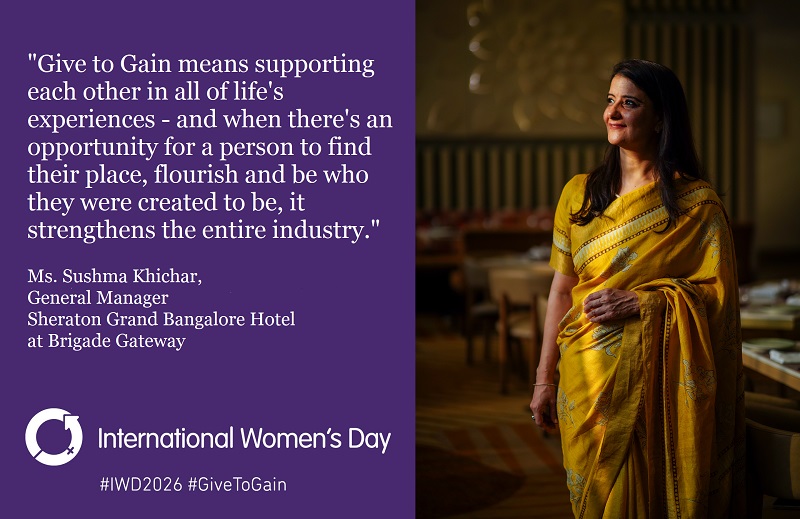
This year’s International Women’s Day theme – “Give to Gain” – could have been written with Sushma Khichar in mind. Her philosophy of leadership is rooted in the belief that investing in others is the most effective strategy for personal and professional growth.
“The phrase ‘Give to Gain’ embodies the true nature of hospitality for me,” she says. “I have seen a direct correlation between the investment of time in mentoring others, creating opportunities, and working with teams on their success, and the subsequent outcomes of loyalty, creativity, and success through collaboration. By supporting others in their travels, I have personally and professionally grown in ways I never thought possible.”
It is a philosophy that has shaped every chapter of her career – and which now infuses the culture she is building at Sheraton Grand Brigade Bangalore, one of the city’s flagship luxury properties.
The Women Who Paved the Way
Asked about the women who inspired her, Sushma speaks with characteristic thoughtfulness – honouring both the visible leaders and the invisible workforce that keeps hospitality running.
“I have been inspired by many of the female leaders in the hospitality industry who have demonstrated perseverance and grace under pressure,” she reflects. “But what is just as impressive is the number of women working quietly behind the scenes each day, providing outstanding operational service while managing their own families and continuing to develop their skills and expertise as professionals.”
That recognition – of the often-unsung contributions of women at every rung of the hospitality ladder – is telling. Sushma’s leadership lens is not narrowly trained on the C-suite; it takes in the entire ecosystem of women who make great hotels possible.
What Women Bring to Hospitality
For Sushma, the qualities that make women exceptional in hospitality are not incidental — they are fundamental to what the industry demands. “Women exhibit many of the same traits — empathy, emotional intelligence, teamwork, and adaptability – which are all critical traits found in the service industry,” she explains. “These traits create stronger teams, a more diverse workplace, and enhance the guests’ experience.”
These are not soft skills, she insists, but core competencies. And as luxury hospitality increasingly pivots towards experiential, personalised, human-centred service, they are becoming more commercially valuable than ever.
A Decade of Change – and What Remains to Be Done
Sushma has watched the role of women in Indian hospitality transform over the decade she has spent rising through senior ranks. “Women have transitioned from their previous guest-facing positions to work in operational and revenue management, engineering, and senior leadership roles,” she notes. “The progress of women in the Indian hospitality industry has occurred through gradual changes that have created visible outcomes throughout the entire sector.”
Yet she is equally clear-eyed about the structural barriers that persist. Unconscious bias, mobility expectations, and the challenge of work-life integration continue to limit women’s progression. Crucially, formal leadership pipelines – particularly for roles in profit-and-loss management and operations – have historically bypassed women, leaving a critical gap in how the industry prepares its future leaders.
“Women in P&L and operations positions do not receive formal training through leadership pipelines, which limits their career progression,” she says, identifying one of the sector’s most pressing structural challenges.
The Sheraton Story: Inclusion in Action
At Sheraton Grand Brigade Bangalore, Sushma has translated her convictions into concrete programmes. The hotel’s all-women-led Horizon organisation is one example – a proudly female team that demonstrates both operational excellence and leadership potential in equal measure. Women currently constitute around 23% of the hotel’s workforce, with active initiatives aimed at expanding that share across every department, including engineering, finance, and valet services – areas where female participation has historically been low.
The hotel is also a participant in Marriott International’s Project Pranita, modelled on the Government of India’s Beti Bachao Beti Padhao initiative. The programme offers young women pursuing bachelor’s degrees in tourism at Indira Gandhi National Open University fully funded hospitality education — covering tuition, travel, housing, insurance, academic support, exam leave, and three structured years of work experience. It is, in essence, a complete pathway into the industry for women who might never otherwise have had access.
The hotel also engages with the National Apprenticeship Promotion Scheme (NAPS), creating on-the-job training pipelines for women, and maintains a gender-neutral pay parity policy – a straightforward but still-vital commitment to fairness across roles.
Tourism as a Model Sector
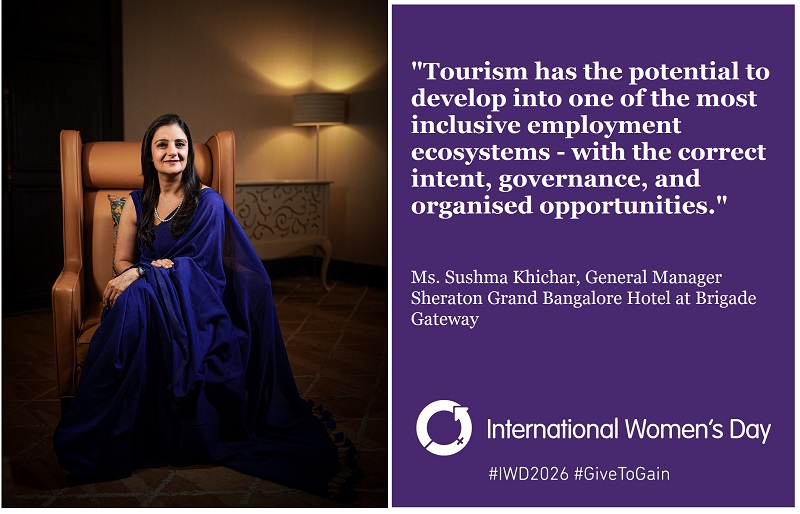
Can tourism become a benchmark for gender equality across Indian industry? Sushma answers without hesitation. “Absolutely. Human connection, empathy, and diversity are essential to the tourism and hospitality industries. The sector has the potential to develop into one of the most inclusive employment ecosystems with the correct intent, governance, and organised opportunities.”
She sees the sector’s inherent character – its emphasis on warmth, service, and human connection – as an advantage rather than a complication. The very qualities that make hospitality demanding are the qualities that, when harnessed well, can make it a genuinely equitable sector. “We are now classified as hybrid hospitality businesses,” she adds, describing how the Sheraton Grand Brigade Bangalore’s positioning at a premier lifestyle destination has expanded the scope of leadership opportunities available to women.
A Vision for the Next Decade
Looking ahead, Sushma’s ambitions are as structured as her approach to mentorship. “My objectives for the next ten years include a significant rise in the number of women in operational and decision-making roles, more clear and transparent career advancement pathways, and stronger leadership pipelines for women,” she says.
If she could initiate one industry-wide programme, it would be a leadership acceleration initiative for high-potential women – identifying them early, and preparing them for senior operational and general management roles through mentorship, cross-functional exposure, and structured training. “Businesses achieve equality through their active commitment to developing leadership potential within diverse groups,” she says, “which creates sustainable progress for the industry.”
The empowerment of women, she adds, is not merely a social good but an economic one. “Women achieve economic independence through job opportunities and leadership positions, which leads to better educational outcomes, stronger local economies, and inclusive development.” A more gender-equal hospitality sector, in her view, is also a more sustainable one – socially, environmentally, and commercially.
Words for the Next Generation
For young women entering hospitality today, Sushma’s advice is characteristically direct and encouraging. “Develop your curiosity while you maintain your determination to find work experience during your first professional years,” she says. “People establish confidence through their active work – they learn from their errors and keep going until they achieve their goals.”
And to her peers – the women professionals navigating the industry alongside her – she offers a message of solidarity: “Believe in yourself, be passionate, seize opportunities, and continue to encourage one another. Sharing achievement makes progress more meaningful.”
As India’s tourism industry continues its remarkable post-pandemic recovery – drawing record international and domestic visitors, adding luxury inventory, and positioning itself as a global destination – the question of who leads it matters more than ever. In Sushma Khichar, the industry has a leader who understands that the answer to that question is not merely a matter of equity. It is a matter of excellence.
– Tourism India, International Women’s Day Special, March 2026 –
