
She walked in at dawn. By noon, the forest had swallowed her.
By Ravisankar KV
In 2022, Malayalam cinema gave Kerala a character it immediately claimed as its own. “Super Sharanya”-written and directed by Girish A.D. and starring Actress Anaswara Rajan – was a coming-of-age story about a young woman tumbling through the ordinary adventures of daily life: impulsive, unscripted, and gloriously undeterred. Audiences loved her not because she was exceptional, but because she was recognisable. She was every young woman who had ever decided, on a Tuesday morning, that life was better explored than planned.
On April 4, 2026, The Television channels in Karnataka and Kerala found their own real-life Sharanya – and the story that followed was far less comic.
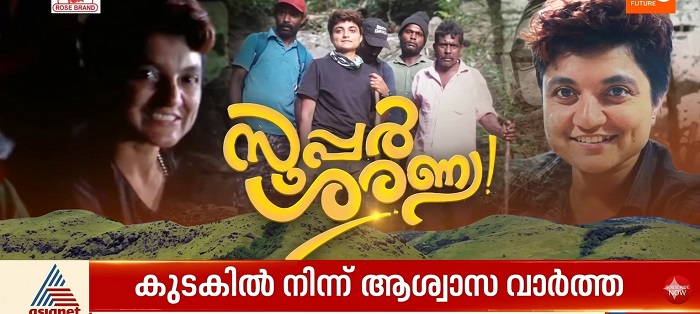
The story of the young woman who vanished into the dense canopy near the Brahmagiri Hills in Coorg – later called India’s “real-life Super Sharanya” by the press – is, on the surface, a story with a happy ending. She was found. She came home. She calmly and confidently told the media and authorities: I am okay, there was no health issue. There was a slight deviation during my descent, my mobile phone switched off due to battery drain, and I lost my way.
She chose to wait near a forest stream, drinking water and enduring the isolation. On the third day, a massive search operation unfolded around her.
And what a search it was.
Her brother flew down from Dubai to Mangalore. More than 100 rescue personnel ventured into different parts of the forest – terrain inhabited by elephants, leopards, sloth bears, and tigers. With Assembly elections just a week away in Kerala, television channels and politicians amplified the urgency, each drawn to the unfolding drama. Chief Ministers, ministers, and senior bureaucrats from both Kerala and Karnataka closely monitored and engaged with the rescue efforts.
She was found. The rescue teams took a bow. The news cycle moved on. The hills returned to being framed for travel reels.
But here is the harder story nobody wants to tell:
she should never have been lost for that long in the first place.
The Boy on the Rock
A few years ago, a similar incident occurred near Palakkad, Kerala.
A teenage boy went trekking with his friends and lost his way on the return. The first night, he stayed on a rock to avoid wildlife. On the second day, he attempted to climb down but became trapped in the middle of a massive rock formation, unable to move up or down.
What followed was a large-scale rescue operation. Fire and rescue personnel were deployed initially. As media pressure and political attention intensified, the government brought in the Indian Army. With the support of local adventure service providers and volunteers, the boy was eventually rescued.
But the cost was staggering.
Hundreds of personnel- from the Army, police, fire and rescue services, trained trekkers, and volunteers – were involved. The financial cost ran into crores of rupees.
All for one boy, one misstep, and one unregulated trail.
The Comfortable Lie of “Accessible”
Tadiandamol rises 1,748 metres above the coffee-scented air of Kodagu. It is not Everest. It is not even considered a technically demanding climb. It is the kind of mountain that appears on “weekend getaway” lists, often illustrated with cheerful stock images.
That is precisely what makes it dangerous.
The Brahmagiri Hills, which straddle the Kerala–Karnataka border, are marketed similarly: eco-tourism, forest walks, misty mornings. These are not sold as challenging terrains. They are sold as destinations for everyone.
And “for everyone” has quietly become a trap for the unprepared.
When a mountain is described as accessible, people stop preparing for it. They set out without GPS devices, without registering emergency contacts, without understanding that a single wrong turn – especially in cloud cover – can lead to hours of disorientation.
Accessibility has not made these places safer.
It has made people arrive less prepared.
A System Built for Rescue, Not Prevention
When the IT professional from Kerala went missing at Tadiandamol, the response was extraordinary.
Forest department teams. Police. Disaster response units. Drone surveillance cutting through the canopy. Sniffer dogs tracking scent. And, most importantly, local tribal communities whose knowledge of the terrain runs far deeper than any GPS system.
Nearly 100 people. Four days. One survivor.
India, it turns out, is highly capable when it comes to rescue. The coordination between Kerala and Karnataka was a quiet example of effective governance: two states, one mission, no bureaucratic delay.
But here is the uncomfortable truth:
every hour of a four-day rescue reflects a failure of prevention.
The role of tribal and local communities is especially telling. They understand the forest: animal movement, terrain behaviour, weather patterns. Yet they remain largely outside formal tourism systems: consulted during emergencies, but rarely included in planning or policy.
That is not just a gap.
It is institutional blindness.
The Women Who Are Outpacing the Infrastructure
Across India’s forests and mountains, something powerful is unfolding. Women are increasingly travelling solo – arriving at trailheads that were once dominated by men.
From Coorg to the Western Ghats and the Himalayas, the trend is unmistakable.
This is not a problem.
This is progress.
But progress without infrastructure creates risk.
The “real-life Super Sharanya” narrative is celebrated as empowerment. But it is also the story of a woman navigating – and surviving – a system that has not evolved fast enough to support her.
The message to solo women travellers should not be be careful.
It should be: You deserve better systems than this – and we are failing to build them.
What a Real Safety Architecture Looks Like
This is not a difficult engineering challenge. The technology exists. The knowledge exists. What is missing is the will to treat adventure tourism as essential infrastructure.
Imagine a baseline system:
- Coordination among various governmental departments and tourism industry associations like the Association of Adventure Tour Operators of India.
- Mandatory digital check-in for every trekker
- GPS-enabled tracking devices, available at trailheads
- Geo-fenced alerts when someone deviates from the route
- SOS systems that work without mobile networks
- Satellite communication and emergency response points
These are not futuristic ideas. They already exist in countries that take outdoor safety seriously.
India needs a framework built on:
- Regulation, not restriction
- Technology integration
- Risk-based zonation
- Mandatory group protocols in wildlife areas
- Communication infrastructure
- Formal integration of tribal communities
Who Else Must Act
Resorts and homestays in regions like Coorg are not passive players. They are the last checkpoint before the forest. A guest heading for a Brahmagiri trek should log their route, timing, and emergency contact before stepping out.
Tour operators must be certified, equipped, and accountable.
And travellers must accept a fundamental truth:
Nature does not adjust to you; you adjust to nature.
Preparation is not paranoia. It is responsibility.
The Third Dimension of Sustainability
For years, tourism in India has focused on environmental sustainability and cultural preservation.
There is a third dimension we have been slow to recognise:
human safety.
A destination that loses travellers – or retrieves them only after days of search and massive public expenditure – is not sustainable.
It is fragile.
The incidents at Tadiandamol in Coorg’s Brahmagiri Hills and the Malampuzha incident in Palakkad must not fade into memory as “successful rescue stories.””
They must become a turning point.
India is positioning itself as a global destination for nature and adventure tourism. The landscapes are extraordinary. The rescue capabilities are impressive.
What remains is the harder work: building systems so strong that such rescues become unnecessary.
The mountains will always be wild.
Our response to them should not be.
