
By Brett Wheeldon, VP, Solution Advisory, APAC, SAP

The next frontier in travel and expense management is not simply spending less. It is giving finance the context to protect high-value activity, remove invisible waste and allocate resources with greater confidence.
For decades, travel and expense has occupied a familiar place in the CFO agenda: a necessary cost category to be budgeted, controlled and reported. The questions have been equally familiar. How much did we spend? Are we within policy? Where can we reduce cost?
Those questions still matter, but they are no longer sufficient. In an environment defined by tighter capital discipline and pressure to deliver profitable growth, finance leaders need to understand not only what a trip cost, but why the investment was made and what business outcome it was intended to support.
That reframes travel and expense from a homogeneous cost line into a portfolio of business investments. A customer renewal, a late-stage opportunity, a strategic project and an internal meeting may carry similar accounting values, yet their commercial purposes are very different. Finance can then reduce low-value activity while protecting the travel that supports revenue, relationships and delivery.
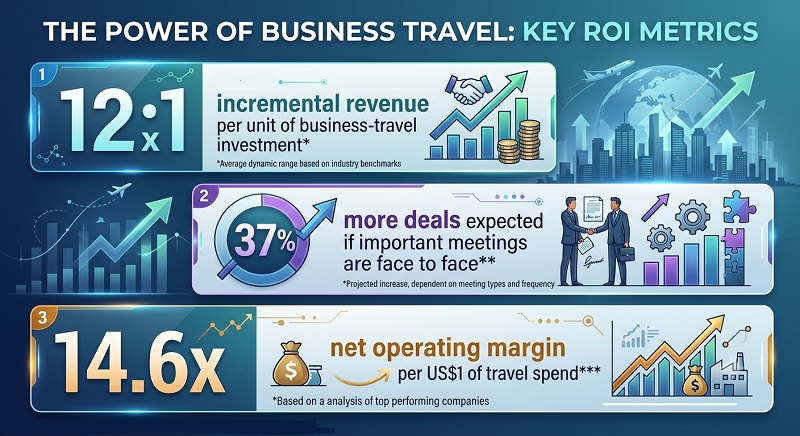
The evidence reinforces the point. Perk’s 2024 research reported that, for small and mid-sized companies, each US dollar invested in business travel generated US$12 in incremental revenue, primarily through new-customer acquisition. Expressed as a currency-neutral ratio for an Indian finance audience, that is approximately ₹12 of incremental revenue for every ₹1 invested, not a foreign-exchange conversion. The same research attributed 34% of 2023 sales growth to in-person meetings and estimated that 30% of travel-driven sales revenue would be lost without face-to-face meetings with clients and prospects.
The visibility gap is the real constraint
Most organisations still see travel and expense too late. Finance typically sees the claim only after the commitment is made, often stripped of the original intent, customer, opportunity, budget or project it was tied to. That limits the quality of resource allocation.
Under pressure, the natural response is a broad reduction in trip volume. That may lower cost, but it can also remove activity connected to acquisition, retention or critical execution. A stronger operating model begins before booking, with a formal request that captures intent and links it to the booking, payment, expense, approval and analysis process.
Cost savings are the entry point, not the finish line
The traditional business case remains important. Manual expense management contains substantial hidden work across employees, managers and finance. Automation, mobile capture, embedded policy and exception-based audit can reduce that burden and focus attention where judgement is genuinely required.
For the CFO, the strategic value is broader. Labour released through automation becomes redeployable capacity. Cleaner information can support a more efficient close. Fewer errors improve confidence. Higher adoption brings more spend into the governed environment. A mature business case should therefore consider cost, risk and income, not processing savings alone.
From digital workflows to intelligent orchestration
Travel and expense maturity progresses from paper to digital workflow, then to intelligent and increasingly agentic systems. The useful finance interpretation is that each stage expands the organisation’s ability to capture value. Digital tools accelerate tasks. Intelligent capabilities add contextual guidance. Agentic capabilities coordinate across systems and act within defined governance.
The objective is not automation for its own sake. It is to move intelligence closer to the decision while preserving human control over strategic choices. Organisations can begin with better capture, policy and workflow, then progressively connect data and apply more advanced intelligence.
The CFO becomes an allocator of travel investment
The most consequential shift occurs when travel and expense data is connected with systems that manage growth. On one side are accounts, pipeline, opportunities, renewals and strategic activity. On the other are requests, bookings, expenses, compliance and cost allocation. Connected, they can change the management conversation.
Finance can ask whether travel was associated with a priority account, opportunity, renewal or critical project, and compare intended purpose with subsequent outcomes. Over time, the business can build evidence about which travel creates value, protects value or should be challenged.
The face-to-face evidence is especially relevant. Accor-commissioned research involving 9,000 professionals found respondents expected to close 37% more deals if all important meetings could be conducted in person, while 81% believed prioritising in-person meetings would improve business outcomes. These are perception-based findings, not audited win-rate data, but they provide a useful hypothesis for CFOs to test against their own CRM, trip-purpose and expense records.
A separate 2025 GBTA and ASTA analysis of 24 years of US data across 14 industries reported US$14.60 in net operating margin for every US$1 spent on business travel, and estimated that an 8.3% increase in travel and entertainment spending could be associated with a 6% increase in sales. These US findings should be treated as external benchmarks, not direct forecasts for an APAC enterprise.
A finance-grade scorecard
The most credible next step is not to apply an external benchmark indiscriminately, but to build an internal scorecard. Useful measures include revenue per rupee of customer-facing travel; opportunity win rate with and without face-to-face engagement; sales-cycle duration; renewal rate; pipeline progression after travel; trip cost as a percentage of opportunity value; and the proportion of travel linked to a defined customer, project or strategic objective.
External ratios should set the challenge. Connected internal data should determine the answer. This approach also recognises that not every trip must generate an immediate financial return. Some outcomes are protective, relational or operational. The goal is to make purpose and assumptions visible, then improve allocation over time.
A better question for the next planning cycle
For CFOs across APAC, the opportunity is to bring travel and expense into the same strategic discipline applied to other investments. Capture purpose at request, guide decisions before commitment, automate routine activity, manage genuine exceptions and learn from outcomes.
The defining question is no longer simply, “How can every trip cost less?” It is, “How can every trip demonstrate its purpose, and how should that evidence influence our next investment decision?” Travel and expense can become a source of financial intelligence, supporting better capital allocation, stronger governance and more confident growth.
“Don’t ask every trip to cost less. Ask every trip to prove its value.”
Evidence notes
* Perk, The Value of Business Travel Report, 13 June 2024. Research covered 2,000 business-travel decision-makers in the UK, US, Germany and Spain. The 12:1 finding was reported for SMB and mid-market organisations.
** Accor-commissioned research reported in November 2024, based on 9,000 professionals globally. The 37% figure is respondents’ expected increase in deals, not an independently observed win-rate uplift.
*** GBTA and ASTA, T&E and the Bottom-Line, July 2025. Analysis of US data from 2000 to 2024 across 14 major industries. Results are US-specific and should be treated as benchmarks rather than APAC forecasts.
