
Digital and connectivity services set to grow fastest as the world fleet nears 45,550 aircraft
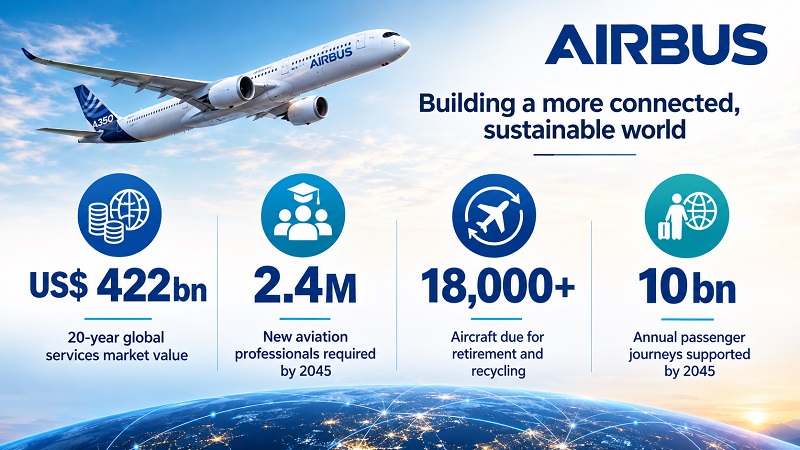
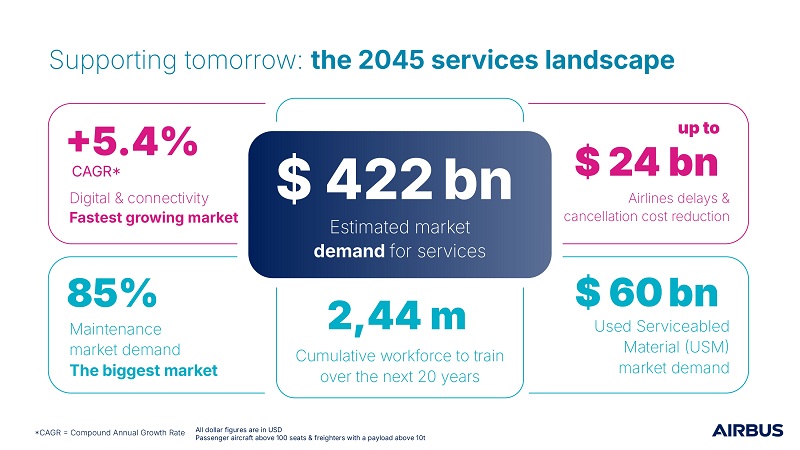
Airbus expects global demand for aviation services to roughly double over the next two decades, from about US209billiontodaytoUS422 billion by 2045. The estimate comes from its Global Services Forecast (GSF) 2026-2045, which projects annual growth of 3.8% over the period.
The market is being driven by a world commercial fleet that is also set to double, to 45,550 aircraft, and by passenger numbers that Airbus expects to reach 10 billion a year by 2045. That means 1.4 billion more people flying than today.
Workforce is a major challenge
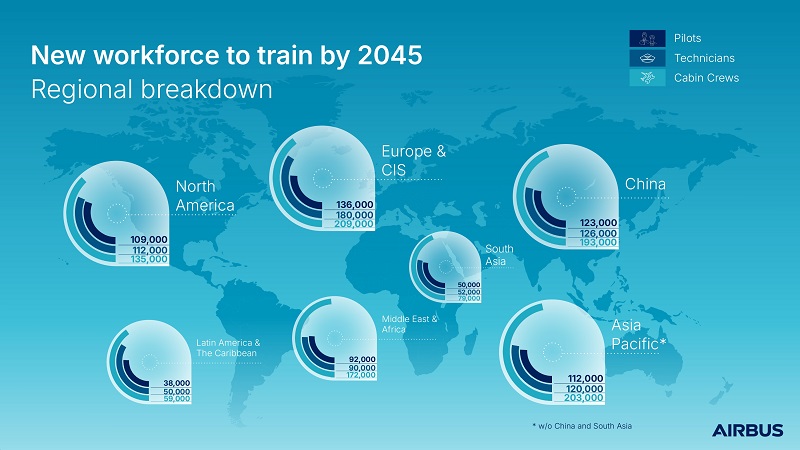
Airbus says the industry will need more than 2.44 million additional skilled people over the next 20 years. That includes 730,000 maintenance technicians, 660,000 pilots and 1,050,000 cabin crew. The manufacturer says airlines and training providers will have to step up recruitment and adopt newer training methods to meet this need.
Six segments, led by maintenance
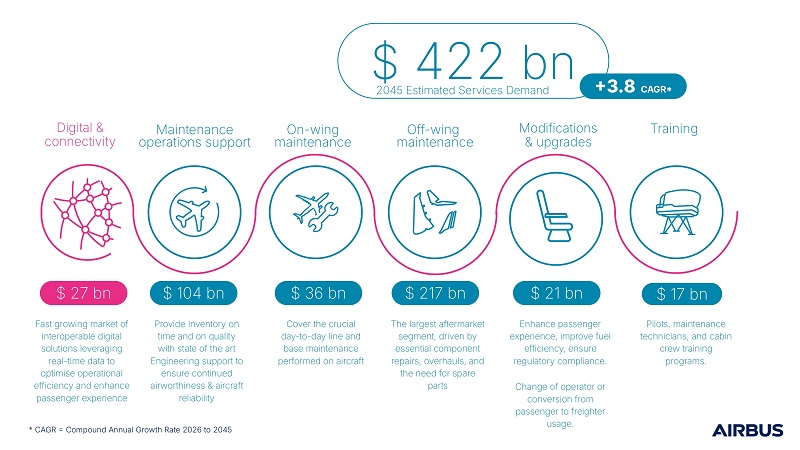
The forecast divides the services market into six segments:
| Segment | 2045 value (US$) | CAGR |
| Off-Wing Maintenance | 217 billion | 3.7% |
| Maintenance Operations Support | 104 billion | 4.3% |
| On-Wing Maintenance | 36 billion | 2.8% |
| Digital & Connectivity | 27 billion | 5.3% |
| Modifications & Upgrades | 21 billion | 2.6% |
| Training | 17 billion | 3.1% |
- Off-Wing Maintenance is the largest segment and is set to double in value. Airbus attributes this to more shop visits as the fleet grows and ages, with parts supply and repair accounting for a large share.
- Maintenance Operations Support is a new category in this year’s forecast. It covers timely, quality inventory provision and the engineering support needed to maintain airworthiness and reliability.
- On-Wing Maintenance, which spans light inspections to heavy checks, is expected to grow broadly in line with the fleet.
- Digital & Connectivity is the fastest-growing segment and is forecast to triple by 2045. Airbus says digital tools are becoming common to all services activities. They help airlines run more efficiently, cut delays and cancellations, make maintenance more flexible and offer passengers real-time connectivity.
- Modifications & Upgrades covers cabin retrofits and the introduction of newer technology on older aircraft.
- Training is expected to grow as the industry works to attract and train new talent.
Older aircraft and used parts
More than 18,400 aircraft are expected to retire by 2045. Airbus says this will make dismantling and Used Serviceable Material (USM) an increasingly important alternative to new parts, easing supply constraints. It forecasts the USM market at US$60 billion in 2045.
Resilient industry, with headwinds
Airbus notes that air traffic has repeatedly recovered from major economic and geopolitical shocks. It acknowledges that operators currently face headwinds, including geopolitical tensions, airspace restrictions, supply chain bottlenecks and fuel prices. In its view, services help airlines adapt to these pressures across the whole aircraft lifecycle.
Cristina Aguilar Grieder, Airbus SVP Customer Services Commercial Aircraft, said Airbus is expanding its role as a services partner across the full lifecycle of the aircraft. Predictive operations, fleet modernisation and digital solutions, she said, help airlines keep fleets available, reliable and safe.
Regional outlook
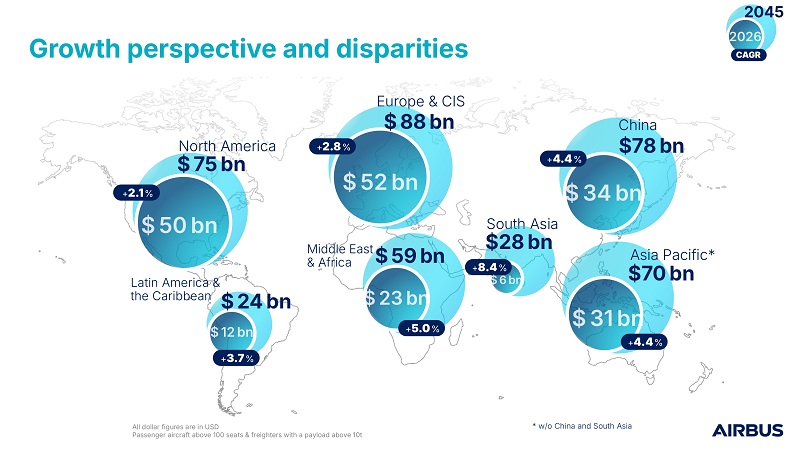
Europe and CIS, North America and China are expected to remain the largest services markets. Asia, comprising Asia-Pacific, China and South Asia, is projected to grow fastest. The GSF covers passenger jets with more than 100 seats and freighters with a payload above 10 tonnes, and it is not tied to any aircraft manufacturer.
