
A pattern of organised tourist fraud – methodical, psychologically sophisticated, and growing in scale – is quietly corroding one of India’s most powerful destination brands. This analysis examines the anatomy of the scam ecosystem operating in Goa, the systemic failures that enable it, the economic damage it inflicts, and the regulatory and industry response that is now urgently required.
By Ravisankar K.V.
Goa does not need an introduction. For more than half a century, it has been India’s most internationally legible tourism brand – a destination that has absorbed the aspirations of generations of travellers, from domestic families seeking their first beach holiday to international visitors drawn by its Portuguese heritage, its coastline, and its distinctly permissive spirit of leisure. It is a brand built not by marketing departments but by accumulated experience, by word-of-mouth recommendation, by the genuine warmth of a destination that knew how to welcome a stranger.
That brand is now under threat – not from a competitor destination, not from a global economic downturn, and not from the forces of nature. It is under threat from within. A growing and increasingly organised ecosystem of tourist fraud, operating with apparent impunity across Goa’s most visited zones, is systematically exploiting the trust that generations of visitors have placed in the destination. And the damage it is doing – to individual travellers, to legitimate businesses, and to Goa’s long-term tourism economy – is far more serious than the occasional anecdotal report would suggest.
This is not a story about petty street crime. It is a story about structured, coordinated, psychologically sophisticated fraud operating at scale – and about the regulatory, institutional, and ethical failures that have allowed it to take root and expand.
I. The Anatomy of the Scam: How It Works
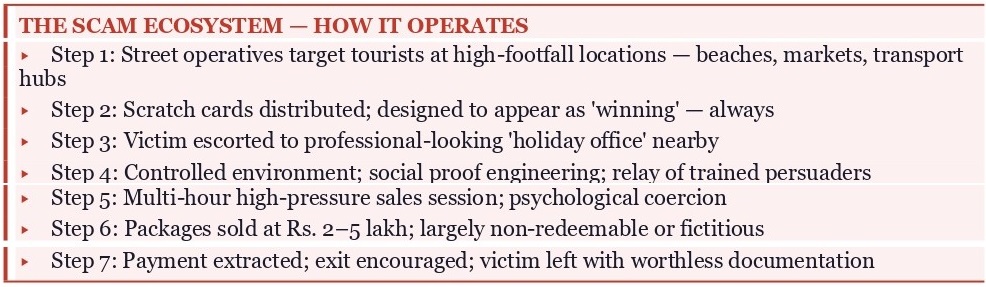
To understand the threat, it is necessary first to understand the mechanics. The most widely reported scam currently operating in Goa is the ‘scratch card’ scheme – a deceptively simple operation that is considerably more sophisticated than its name implies.
The operation typically begins on the street, in the vicinity of popular tourist attractions, beaches, markets, and transport hubs. Operatives – often well-dressed, articulate, and apparently friendly – approach tourists, with couples and first-time visitors to Goa being particularly targeted. The tourist is handed a scratch card and invited to play. The card is, of course, designed so that the target appears to win a reward – a holiday package, a resort stay, a prize of significant monetary value.
What follows is a textbook exercise in psychological manipulation. The ‘winner’ is escorted – willingly, at this stage – to a nearby office, which may be presented as a travel company, a holiday membership centre, or a tourism promotion outfit. The environment inside is carefully managed: professional décor, uniformed staff, printed brochures, and the social proof of other apparent ‘members.’ The target is now in a controlled space, separated from the street.
This is not casual street-level cheating. It is a structured, coercive ecosystem designed to exploit the trust and excitement of a visitor at their most open and relaxed moment.
Inside, the high-pressure sales environment begins. Staff employ a relay of persuasion techniques – urgency creation, artificial scarcity, social pressure, appeals to the guest’s self-image as a sophisticated traveller – to push the target towards purchasing a holiday membership package. Prices quoted range from Rs. 2 lakh to Rs. 5 lakh and beyond. Targets report being subjected to these environments for hours, with exits subtly discouraged.
The packages sold are typically either entirely fictitious, grossly misrepresented relative to what is promised, or so heavily condition-laden as to be practically unusable. In most cases, the ‘resort’ or ‘holiday club’ membership cannot be redeemed in any meaningful way. The money, once paid – often under significant psychological duress – is effectively unrecoverable.
THE SCAM ECOSYSTEM – HOW IT OPERATES
What makes this operation particularly difficult to counter is its professional infrastructure. These are not amateur operations. They have physical premises, printed materials, staff hierarchies, scripts, and – critically – legal structures that provide a veneer of legitimacy. This is organised fraud, operating behind a facade of legitimate business, in one of India’s most heavily visited tourist destinations.
II. This Is Not an Isolated Problem: The Wider Ecosystem of Unethical Practice
The scratch card scam, while the most visible manifestation of the problem, is not the only unethical practice degrading Goa’s tourism environment. A broader pattern of exploitation is apparent to any honest examination of the current landscape.
Street-level harassment and touting – the aggressive solicitation of tourists by unlicensed operators offering transport, accommodation, excursions, or restaurant services – remains pervasive in key tourist zones. While often perceived as a minor inconvenience, sustained touting harassment materially degrades the visitor experience and creates an environment of wariness and distrust that works against the open, relaxed atmosphere that is Goa’s primary experiential offering.
Fake travel memberships and holiday schemes – distinct from but related to the scratch card operation – have been reported with increasing frequency. These involve the sale of supposed long-term membership packages in non-existent or non-functional holiday clubs, often conducted through social media leads and follow-up office visits.
Rental fraud – the misrepresentation of vehicles, accommodation, and water sports equipment in terms of condition, safety, or pricing – has generated a significant volume of consumer complaints. The particular danger of misrepresented water sports safety standards extends beyond financial harm to genuine physical risk.
Perhaps most structurally damaging is the practice of hotel and hospitality classification fraud – the systematic misrepresentation of property categories to regulatory bodies, enabling operators to collect premium pricing while evading the tax and compliance obligations of their actual category. This practice is not merely dishonest to the guest; it undermines the competitive environment for legitimate, compliant operators and creates a structural subsidy for dishonesty.
Each individual scam is a transaction. But together, they constitute a culture – and a culture of exploitation, once established in a destination, is extraordinarily difficult to reverse.
III. The Economics of Reputational Damage: What Is Actually at Stake
It is tempting to frame tourist scams as a problem for the individual visitor – unfortunate, regrettable, but ultimately containable. This framing dangerously underestimates the economic stakes.
Goa’s tourism economy is not a peripheral sector – it is the state’s primary economic engine. Tourism contributes approximately 16% of Goa’s GDP and supports, directly and indirectly, the livelihoods of a substantial proportion of the state’s working population – from hoteliers and restaurant owners to taxi drivers, beach shack operators, artisans, and service workers. Any significant erosion of tourist confidence does not merely affect visitor numbers; it cascades through an entire local economy.
The mechanism of reputational damage in the digital age is particularly unforgiving. A tourist who leaves Goa having been victimised by a scam does not simply share the experience with a few friends. In the ecosystem of reviews, social media, travel forums, and video content that now shapes destination perception globally, a single documented negative experience can reach tens of thousands of prospective visitors within days of being posted. The Kerala couple whose near-miss with the scratch card scam became widely circulated – across news outlets, social media platforms, and travel communities – is a precise illustration of this dynamic.
THE ECONOMIC IMPACT CHAIN: HOW SCAMS DAMAGE A DESTINATION
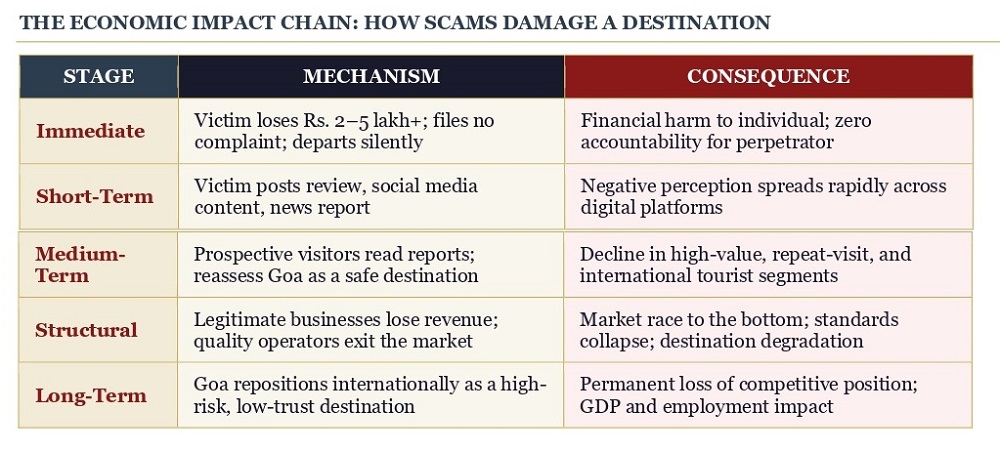
The most damaging segment to lose is the high-value, internationally connected visitor – precisely the demographic that Goa’s long-term tourism strategy depends upon. These are travellers who exercise the highest levels of digital due diligence before booking, who have the widest alternative destination options, and whose negative experiences carry the greatest amplification potential. When this demographic begins to route around a destination on safety grounds, the damage to the tourism economy is disproportionate to their numbers.
Repeat visitation is the second critical metric. Goa’s tourism economy has historically benefited from a high rate of return visitors — travellers who come back annually or seasonally, whose spending is predictable, and whose advocacy is the most credible form of destination marketing that exists. A single bad experience, particularly one involving financial fraud, has a near-zero probability of generating a return visit. The scam ecosystem is, in effect, systematically converting Goa’s most loyal guests into its most vocal detractors.
IV. The Question of Complicity: Who Is Enabling This?
Any serious analysis of the Goa scam ecosystem must confront an uncomfortable question: how are these operations functioning with such apparent openness, in such prominent locations, over such an extended period, without effective intervention?
The answer requires an honest examination of several possible explanations — each uncomfortable in different ways.
The first is straightforward institutional failure: regulatory agencies and law enforcement lack the resources, the mandate, or the operational intelligence to effectively identify and prosecute sophisticated fraud operations that present a veneer of legitimate business. This is a genuine challenge, and it would be unfair to reduce a complex enforcement problem to simple negligence. Organised fraud that operates behind the façade of a registered company, with professional premises and printed documentation, is genuinely difficult to prosecute under existing consumer protection frameworks.
The second explanation is more troubling: the possibility that parts of the broader hospitality and tourism ecosystem derive indirect benefit from the scam infrastructure, or at minimum exercise strategic silence in preference to active opposition. This might take the form of referral arrangements, shared premises, or simply the commercial calculation that drawing attention to the problem invites scrutiny of one’s own compliance record. Whatever the mechanism, the practical effect is that reputed industry players have not, in sufficient numbers or with sufficient force, taken a public stand against practices they are aware of.
If the industry does not regulate itself, it will eventually be regulated from outside – more harshly, less favourably, and without the nuance that the industry would bring to its own governance.
The third explanation relates to the structural complexity of the tourism value chain. The boundary between legitimate time-share and membership holiday products – which do have legal standing – and fraudulent schemes designed to extract money under false pretences is not always immediately apparent to the casual observer, including the regulatory authority. This ambiguity has historically created space for bad actors to operate in the grey zone between hard fraud and aggressive but technically legal selling.
None of these explanations constitutes an excuse. They do, however, shape the nature of the response required – which must be more sophisticated than simple condemnation, and more targeted than a generalised crackdown that might damage legitimate operators alongside fraudulent ones.
V. Government Responsibility: Enforcement Cannot Remain Optional
The role of the Goa Tourism Department and of the state’s law enforcement agencies is now critical. What is required is not incremental adjustment but decisive, structured, and sustained intervention across several fronts simultaneously.
The regulatory framework must also address the question of deterrence more seriously. The current enforcement environment appears to offer insufficient disincentive to operators who have calculated that the probability of prosecution, multiplied by the severity of the penalty, is less than the profitability of the operation. This calculus must change. Criminal prosecution – not merely civil penalties or licence revocations – must become a credible and consistently exercised consequence for organised tourist fraud.
The state government should also consider the creation of a formal Tourism Ethics Board – a statutory body with representation from government, industry associations, consumer groups, and civil society – empowered to set and enforce ethical standards across the tourism ecosystem, conduct investigations, and recommend regulatory action. Such a body would provide the institutional continuity that enforcement initiatives driven by individual political cycles often lack.
Central government engagement is equally important. India’s ambition to position itself as a top-five global tourism destination by 2030 – and the significant promotional investment that ambition represents – cannot be credibly sustained if iconic destination brands like Goa are associated, in the global travel press and consumer consciousness, with systematic tourist exploitation. The Ministry of Tourism should treat Goa’s scam ecosystem as a national tourism governance priority, not a state-level administrative matter.
VI. The Industry’s Obligation: Self-Regulation or Surrender
The hospitality and travel trade industry – hotels, licensed travel agents, tour operators, and industry associations – cannot afford to treat the scam ecosystem as someone else’s problem. The reputational damage that accrues from unethical practices operating in their market does not respect the distinction between legitimate and illegitimate operators. When a visitor is defrauded in Goa, it is Brand Goa – and by extension, every legitimate business that depends on that brand – that suffers.
The industry’s response must therefore be active, not passive. The time for strategic silence – for the calculation that it is better not to draw attention to the problem than to risk collateral scrutiny – is over. The reputational mathematics have changed. The cost of inaction now exceeds the cost of confrontation.
Associations such as FHRAI, TAAI, IATO, and the Goa Tourism Association have the institutional standing to lead this effort. The credibility that these bodies carry – with government, with the media, and with the public – is a significant asset that is currently being underused. A coordinated, industry-led campaign against tourist fraud, backed by visible enforcement cooperation and genuine self-regulatory mechanisms, would send a signal both to bad actors and to prospective visitors that Goa’s legitimate industry is serious about its own standards.
VII. Goa in the National Context: A Warning for Indian Tourism
It would be a mistake to read this analysis as being solely about Goa. Goa is the most visible case – because it is India’s most internationally profiled leisure destination, and because the scale of its visitor numbers creates both the opportunity and the visibility for organised fraud. But the systemic vulnerabilities that Goa’s situation exposes are present, to varying degrees, across many of India’s major tourism destinations.
India’s tourism strategy at the national level is, rightly, ambitious. The country’s target of 100 million international tourist arrivals annually – and the promotion investment that this ambition requires – is predicated on the assumption that India can offer not merely attractive destinations but a safe, trustworthy, and consistently high-quality visitor experience. The Goa situation exposes the gap between promotional ambition and governance reality that currently exists.
Marketing campaigns can attract tourists. Infrastructure investment can improve access. But only governance and ethical standards can produce the trust that converts a one-time visit into a pattern of repeat engagement and positive advocacy. India’s most powerful tourism asset is not its monuments or its beaches – it is the genuine warmth and hospitality of its people. Any organised system that exploits that warmth as a vehicle for fraud is not merely damaging a destination; it is corrupting the foundation on which Indian tourism’s global reputation must be built.
India’s most powerful tourism asset is not its monuments or its coastline – it is the trust that visitors place in the warmth of its welcome. Organised fraud does not merely steal money. It steals that trust.
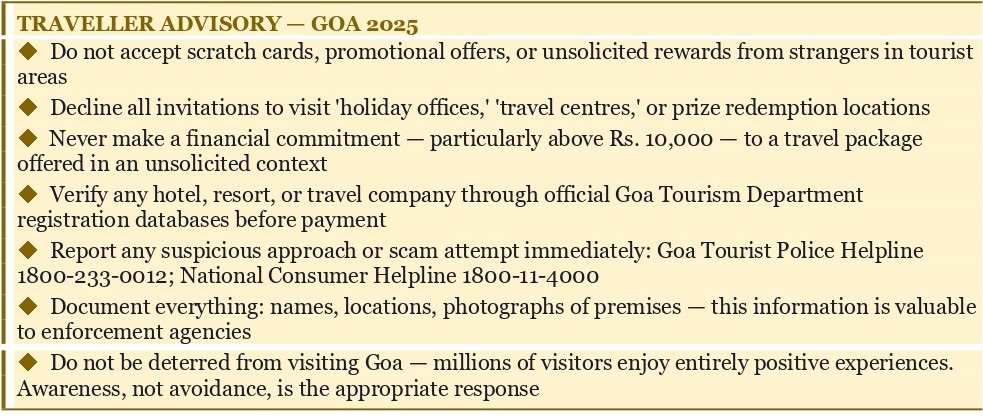
VIII. Advisory for Travellers: How to Stay Protected
Until regulatory and industry mechanisms provide more effective protection, visitors to Goa and other major tourist destinations in India must exercise a heightened level of awareness. The following guidance reflects the current risk environment:
IX. The Path Forward: Three Imperatives
Goa stands at a genuine crossroads. The scam ecosystem currently operating within its tourism environment is not, at present, existential in its impact – but the trajectory, if unchecked, runs towards serious and potentially irreversible reputational damage. The window for effective intervention is open. It will not remain open indefinitely.
The path forward is not complicated in its conception, even if it is demanding in its execution. It rests on three imperatives that must be pursued simultaneously and with genuine commitment:
First, accountability – which requires the criminal prosecution of identified fraud operators, the dismantling of the institutional and commercial infrastructure that supports them, and the public naming of those who have enabled the ecosystem through negligence or complicity. Accountability without consequences is performative. Consequences must be real, swift, and proportionate.
Second, enforcement – which requires not a single high-profile operation but a sustained, intelligence-led enforcement presence in the locations where fraud is known to operate, backed by a regulatory framework that closes the legal grey zones that bad actors currently exploit. Enforcement must be resourced, professional, and maintained across political cycles.
Third, awareness – which requires a coordinated effort across industry, government, and media to ensure that both prospective visitors and domestic tourists understand the nature of the risks, know what legitimate hospitality looks like, and are equipped with the tools to report and respond when they encounter the alternative.
Goa has built its tourism brand over half a century of genuine hospitality, extraordinary natural beauty, and a cultural character that is uniquely its own. It is not too late to defend that brand. But it requires, from government, from industry, and from the wider society that depends on tourism for its livelihoods, a level of collective seriousness that has not yet been fully demonstrated.
Tourism cannot survive without trust. And trust, once broken at scale, does not repair itself. It must be rebuilt – deliberately, consistently, and at considerable cost. The time to act is now, before that cost becomes the only option.
Also Read
CGH Earth unveils Sanctuary Amaidiyana
Watch on Youtube
